Followers

Friday, September 8, 2017

Ed Tech Doctoral Journey Pt. 3- The role of theory.


Before I began advanced graduate coursework I never stopped to consider the importance of theory and what bearing it has on practice. The term theory always had a highly academic and conceptual feel to it and I never considered how important it is to practitioners. When I think of the difference between theory and practice, I think of theory being located in a lecture hall in a university, and practice being nicely situated in K-12 classrooms. Little did I know that both are ubiquitous in each location. I endeavor to be a scholar-practitioner and I leaned what the significance is in considering both in what I do as an instructional coach, teacher, and researcher.
            A theoretical or conceptual framework reflects one’s unconscious assumptions about the world; a person’s world view which in turn affects one’s view of research (Thomas, 2013). As researchers we have assumptions and strong beliefs formed by our lives but we can not contextualize citing the experiences we had growing up or in our present lives. We must become fluent in the theory and research that forms the context of our research problem (Thomas, 2013). Theory is needed for a study to provide context for the research topic and helps to situate the problem in the chosen discipline. Theory assists in framing the problem, purpose, and analytics of a study by providing a context to scaffold and develop a solid research study (Laureate, 2016l).
            According to Ravitch and Carl (2016) a conceptual framework makes the case for why a study is significant and relevant, how the study design answers the research questions. The conceptual framework is comprised of several items. The components of a conceptual framework include: research questions, goals, context, the researchers themselves, theoretical framework, tacit theories, structured reflexivity and dialogic engagement, and methodological approach and research methods (Ravitch & Carl, 2016). The conceptual framework creates a link between context, theory, and the way that they study is organized and carried out in relation to all of the influences of context.
            Ravitch and Carl (2016) wrote that “the role of theory is central in developing and iterating qualitative studies in formative, ongoing, and summative ways” (pg. 85). Single (2009) wrote that writing research is the process of contributing to a filed where the researcher “shifts from being a consumer of knowledge to a contributor” (pg. 34). The researcher enters into a conversation and that process takes patience, humility, and the recognition of others expertise and work that has come before. Theory helps to add more dimensions and layers of understanding about a phenomenon. Theory helps to deepen and extend our understanding of these concepts by conceptualizing their construction and meaning (Ravitch & Carl, 2016).


References

Laureate Education (Producer). (2016l). Theoretical/conceptual framework[Video file]. Baltimore, MD: Author.

Ravitch, S. M., & Carl, N. M. (2016). Qualitative research: Bridging the conceptual, theoretical, and methodological. Thousand Oaks, CA: Sage Publications.

Single, P. B. (2009). Demystifying dissertation writing: A streamlined process from choice of topic to final text. Stylus Publishing, LLC.


Thomas, G. (2013). How to do your research project: A guide for students in education and applied social sciences. Sage.

Sunday, August 27, 2017

Launch Hays District PD Conference

For the second time since its inception, Hays CISD has hosted a district wide professional development conference where by all of the 1700 faculty and staff meet to enjoy a day of learning, exploration, and camaraderie. This day is wonderful event where teachers can re-connect with each other and reinvigorate their spirit of life long learning with newly acquired knowledge, tools, and practises which can be transferred into the classroom for the benefit of all nearly 20,000 of our waiting students.

I am so proud and honored to be part of this event. The realization of a life lone dream of mine to support teachers has come to fruition. Being given the change to impact the academic success of our students is something that I do not take lightly. The presentations I developed were fine tuned to sustain a session that included a balance of training and hands on so that teachers could at least begin the creation of something that could be utilized within the first few days of school.

At the end of my presentations I include a link to a Google Form that has been created for participants to provide my feedback on the quality of the presentation and questions/topics they have going forward. I am still nervous at times to see how I have been rated becasue of the perfectionist in my wants to reach all the needs of my participants and make sure that the quality is the very best I can provide. I have been honored and truly touched by some of the feedabck that I have received. It continually gives me confidence that I am growing as an insturctional coach and leader. I know that I still have much to learn and I look forward to continuing my personal and professional growth.

I am excited to continue to work with teachers who want to delve deeper into technology integration. The countdown has begun, ignition is moments away, this launch will be momentous.

Tuesday, August 15, 2017

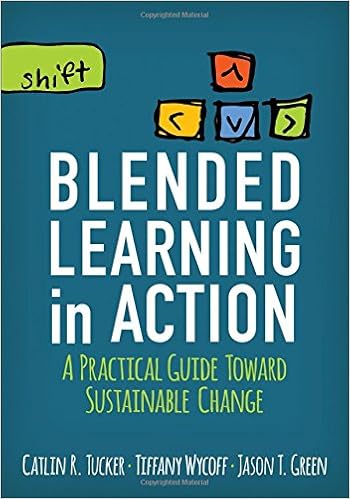
Reflections on, "Blended Learning in Action" by Tucker, Wycoff, and Green. Ch. 1


I am so glad that Tucker, Wycoff, and Green (2016) offer to provide us with a good definition of what blended learning (BL) is. I find that there are many educators that have a vague or inaccurate perception of BL. In Chapter 1, Tucker et. al. (2016) wrote that BL is:

"[I]is a formal education program in which a student learns: (1) at least in part through online learning, with some element of student control over time, place, path, and/or pace; (2) at least in part in a supervised brick-and-mortar- location away from home; (3) and the modalities along each student's learning path within a course or subject are connected to provide an integrated learning experience" (pg. 6).

The importance of addressing culture can not be underestimated when attempting to integrate a new program or system. I am happy to know that the authors address this since it is a well researched approach. For instance, Rogers (2003) wrote that when an agent of change is attempting to engage in a process whereby an innovation like BL is diffused into an organization, the culture of the organization must be respected. "Change agents' success in securing the adoption of innovations by clients is positively related to a client orientation, rather than to a change agency orientation" (pgs. 374-375).

We must begin with the culture and work within the system. That is the most successful approach to truly make impactful change!


References

Tucker, C. R., Wycoff, T., & Green, J. T. (2016). Blended Learning in Action: A Practical Guide Toward Sustainable Change. Corwin Press.


Rogers, E. M. (2003). Diffusion of innovations (5th ed.). New York, NY: Free Press. 

Reflections on, "Blended Learning in Action" by Catlin R. Tucker.

https://www.google.com/search?q=Blended+Learning+in+Action&source=lnms&tbm=isch&sa=X&ved=0ahUKEwiJ6tO49dnVAhUE02MKHYkIC-wQ_AUICygC&biw=1530&bih=845&safe=active&ssui=on#imgrc=Gj77EQmOU6a6BM:


Blended Learning (BL) is an intriguing concept in education. I consider myself a novice when it comes to knowing what makes BL successful, however, I look forward to learning more. The Digital Learning Team will embark on a book study so that we will be able to learn more about blended learning from this book.

In chapter 1, Shifting to a Blended Culture, a poignant question was posed by one of the authors, "How do we create quality education at scale that works for every student and honors their individuality as learners?" (Tucker, Wycoff, Green, 2016, pg. 3). As a teacher of 15 years, the struggle to create a classroom that answers this question, and honors the individuality and learning preferences of all my students is one that I agonized over every year. I admit, that despite my very best attempts, I regrettably failed to create a system that was 100% effective in my estimation. The author wrote that he grappled with that very question for almost 20 years so I don't feel too bad, and I am happy that I think I may get to learn how this is done in less than 20 years. I hope to be able to teach others for the benefit of their students! Tucker et. al. (2016) wrote that when implemented well, blended learning environments create the possibility, not the guarantee, for every student to experience precisely the learning he or she needs.

I am excited to learn more about BL and to have resources available to assist teachers to integrate and sustain BL environments.


References


Tucker, C. R., Wycoff, T., & Green, J. T. (2016). Blended Learning in Action: A Practical Guide Toward Sustainable Change. Corwin Press.

Thursday, August 10, 2017

I never knew that coding could be so easy.


I had the pleasure of attending a Coding Academy given by RePublics CS using the free web based software Scratch created by MIT. RePublics created lesson plans for teachers to implement a skills based and best practice pedagogy. The training itself was an amazing two day training where were leaned both the scratch and RePublics CS platforms. For the rest of this post I would like to focus on the Scratch platform.

Scratch is a free web based coding platform that was created by MIT and designed for students age 8-16 but can definitely be used for ages outside that range. I have very little experience with coding before I attended this professional development. When day two of this two day training had concluded, I was so much more confident and at ease about the entire process of coding. Here is a snap shot of an artifact that I created.


I will leave you with this thought, coding is something that you can do, and scratch makes it easy!